Photo Caption
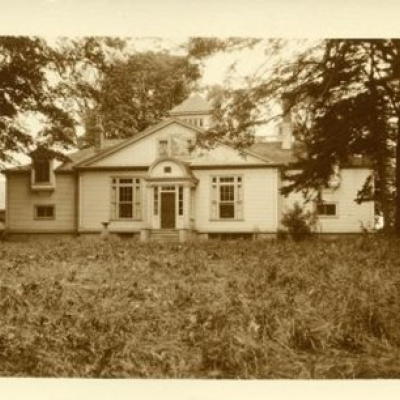
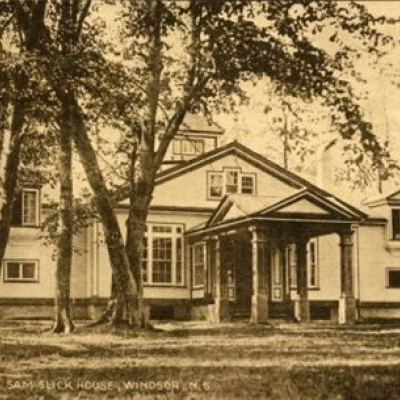
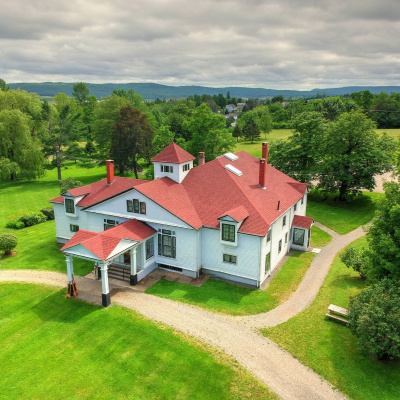
The Clifton house and grounds have undergone many renovations to suit the changing needs of its varied occupants, used as everything from a gentleman's estate to poor relief housing, a hotel, a gypsum mine, and a tearoom.
Photo Credit
Clifton, by W. Bartlett, published in 1842. NS Archives.


Photo Caption
Watercolour believed to be painted by one of Haliburton’s daughters. The water in the foreground suggests gypsum quarry was no longer in operation at the time of painting.
Photo Credit
NSM 89.95.7.
Haliburton’s Clifton
When Thomas Chandler Haliburton decided to build his estate in Windsor, Nova Scotia, in the 1830s, the township had a reputation for beauty, social prestige, and, of course, King’s College – where Nova Scotia’s elite sent their sons to be educated. Windsor was also home to Haliburton – where he had been born and educated. And so, it made sense for the up-and-coming author, lawyer, judge, politician, and businessman, with his family of eight children, to build his estate in Windsor on land he already owned overlooking the town.
Clifton, named for the English birthplace of his wife Louisa Neville, was designed and built to enhance Haliburton’s status as a ‘gentleman’ in Nova Scotian society. The house was often the center of upper-class social events in Windsor, hosting dinners and parties with dancing, music, and cards for the “proper sort” of guests from Windsor and travelling from Halifax.

Photo Caption
Reception Room at Clifton Museum Park
An Early Sunset
The touches of Louisa Neville Haliburton were seen throughout Clifton – from the estate gardens to the elegant drawing room. In 1841, only five years after Clifton had been completed, Louisa died at the age of 48. With the help of his children, Haliburton continued to maintain the estate until 1856, when he moved permanently to England.
Changing Owners, Changing Estate
In 1856, Haliburton sold Clifton to James P. Pellow, a resident of Windsor who had made money in the California Gold Rush. Pellow was a successful merchant and owned several properties and gypsum mines in the area, including the Clifton Hotel. Pellow's largest gypsum mine was the Clifton Quarry, located on the estate. It was one of the largest gypsum suppliers in Nova Scotia, providing twenty to thirty thousand tons a year. Pellow, his wife Mary Smyth, and four children lived at Clifton until Pellow’s death in 1871, when the property was sold, and his remaining family moved away.
Senator Ezra Churchill of Hantsport bought the property in 1871 to better host large gatherings in his retirement. His Dominion Day celebrations were particularly grand, with musicians and singers brought in to entertain the crowds. When he passed three years later, his sons had little use for the property. They chose to rent it out to a long series of tenants for the next 47 years.
In 1904, the house was turned into the Sam Slick Hotel. This resulted in an extension with 10 bedrooms being added to the east side. The hotel was not financially successful and closed shortly after.
The final private owner, Norman Corstophen, added a new raised roof, which evened out the previous collection of small room peaks and valleys that had a long history of leaks, as well as the porte-cochère (carriage porch) to the main entrance. The old roofs are still intact and visible from inside the attic.
Clifton would pass through sixteen owners and tenants and many cycles of neglect and repair before the province opened it as a museum in 1939. Each owner changed Clifton in their own way to suit their own purposes for the property. The architectural changes seen in the house provide glimpses into the evolution of Nova Scotian life and society.
Today, visitors to Clifton Museum Park still find echoes of how the estate would have functioned during Thomas Chandler Haliburton's aristocratic days. However, the spirit of Clifton as a gathering point most closely reflects its history. In addition to the historic house museum and large public park, it hosts the Birthplace of Hockey Museum and the Clifton Disc Golf Course.